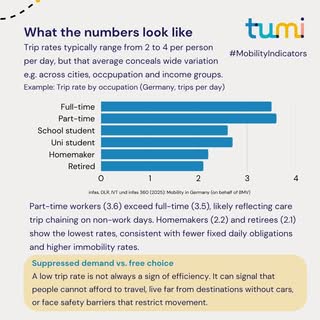
Trips per Person per Day and what it is used for #MobilityIndicators
Here’s what transport models often miss: the trip from home to work and back looks clean and simple on paper. The chained trip pattern that integrates childcare, healthcare, family care, and shopping looks messy. But the messiness is not inefficiency. It is the invisible infrastructure of daily life – and it is overwhelmingly carried by women.
When we treat all trips as equivalent – a commute and a school escort, a leisure trip and a care run – we build systems that serve one kind of traveller and assume everyone else will adapt.
They don’t adapt. They absorb the cost. In time, in stress, in trips that couldn’t be made.
Trips per person per day tells you how much a city moves. Mode share tells you how. Participation tells you who gets left out. Use all three together – and always ask whose trips are being counted, and whose are being assumed away.
That’s the difference between a transport indicator and a transport policy.