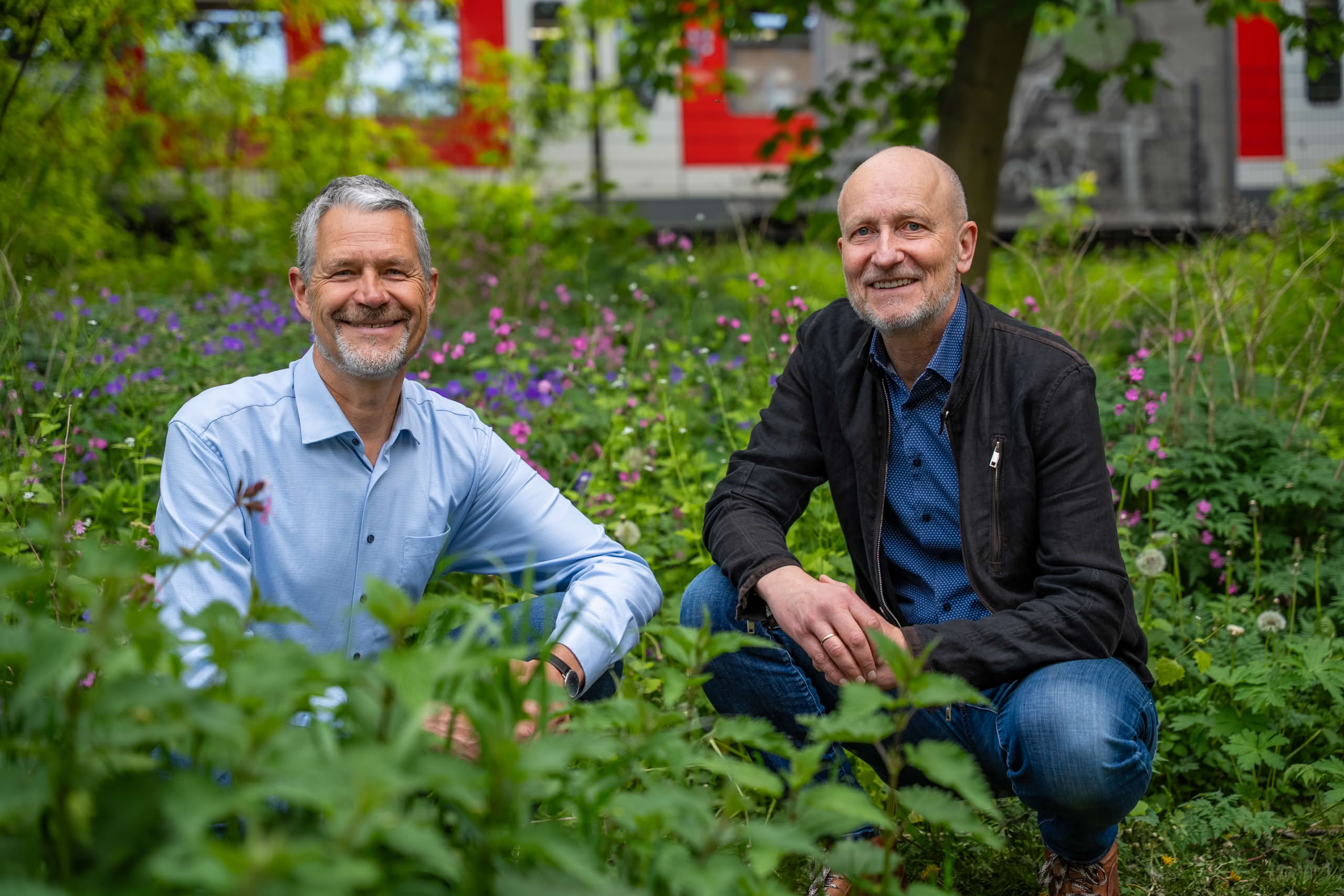
The joint inititative “Blühende Haltestellen” (“Blooming Stops”) by the Deutsche Wildtier Stiftung (German Wildlife Foundation) and the Hamburg Transport Association (hvv) has transformed species-poor patches of grass around transit stations into vibrant havens for wild bees and other insects.
The results speak for themselves. Monitoring conducted in 2022 and 2024 recorded an impressive 198 species of bees and wasps at the sites — including 19 species on the Red List of endangered species and 22 flower-specialist wild bee species.
– an Interview with Dirk Carstensen (hvv) and Simon Henze (hvv)
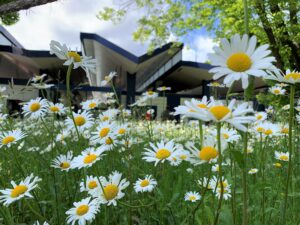
Burgstraße wildflower area
How did the idea (in collaboration with the Deutsche Wildtierstiftung) to link mobility and biodiversity in this way come about?
In our work around rapid transit stations in Hamburg, we have repeatedly noticed that numerous urban green spaces along streets and paths—which are clearly visible to passengers—are maintained primarily as simple lawns but are otherwise scarcely landscaped. As a result, they do not catch the eye and do not contribute to the quality of the public space. The German Wildlife Foundation is committed to protecting native wildlife and its habitats and, even before the project began, had already transformed areas in Hamburg into flowering habitats for wild bees and other insects. We successfully brought these different interests – “passengers” and “wild bees” – together through the joint project “Blossoming Stops.”
What specific ecological results have you observed so far—and what has surprised you the most?
The accompanying monitoring demonstrates the success of the joint project: In 2022 and 2024, a total of 198 species of bees and wasps were recorded on land managed by the German Wildlife Foundation, including 19 Red List species and 22 flower-specialized wild bee species. This means that these areas account for approximately 26 percent of Hamburg’s stinging insect fauna and demonstrate that even small urban sites can serve as important stepping stones in the network of habitats.
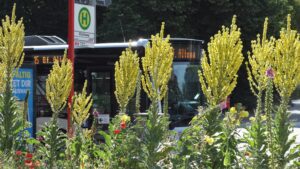
Schlump wildflower area
What feedback have you received from the public?
Feedback from passersby, public transportation companies, the City of Hamburg, and the media has been consistently positive. However, flower beds outside their blooming season do not necessarily conform to conventional notions of beauty. Therefore, during the off-season, it is necessary to explain why these areas may appear temporarily unkempt or neglected.
Which partnerships were crucial to successfully implementing this collaboration, and what were the key factors for success?
The foundation’s technical expertise and financial resources were key to the successful implementation of the project and to fostering a positive, trusting collaboration – neither of which we possess. However, the City of Hamburg’s willingness to grant us the use of the sites for redevelopment was also crucial. So far, we have received volunteer support at only three sites. However, that is where the maintenance efforts are most intensive.
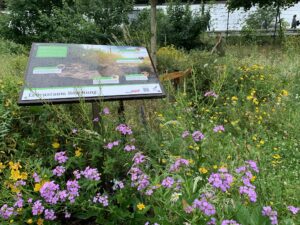
Sternschanze wildflower area
What challenges did you have to overcome, and what would you do differently today?
In addition to finding suitable sites near transit stops (clearly visible to passengers, sunny, free of waterlogging, not used as a thoroughfare by pedestrians, and accessible by vehicle for maintenance), financing is the main challenge. This is because creating and maintaining flower beds is significantly more expensive than the lawn maintenance previously carried out by the City of Hamburg.
We would have liked to see more support from the relevant authorities and more collaboration with other organizations in Hamburg that are creating flower beds. We’re still working on that.
Looking ahead to the future: What is the HVV’s vision for a mobility infrastructure that benefits people, the climate, and biodiversity equally? What role should biodiversity and nature-based solutions play in this vision in ten or twenty years?
The importance of walking for an attractive public transit system is increasingly coming into focus, as passengers primarily walk to their stops. Against this backdrop, making walking more appealing in Hamburg plays a central role: walking and public transit go hand in hand. This includes creating attractive, safe, direct, and accessible pedestrian paths as essential components of passengers’ mobility chains. During hot weather, the temperature on our green spaces is significantly lower than on adjacent sidewalks. For passengers, shade in waiting areas is (increasingly) important. Trees also contribute significantly to improving the quality of the environment. Finally, it would be beneficial if surfaces were sealed only where necessary for the use of the area. So far, surfaces have also been sealed simply because it is the cheapest option.
Where do you see the greatest potential for integrating nature-based solutions even more strongly into the planning and design of mobility spaces in the future—beyond just transit stops?
In the coming years, the city of Hamburg plans to install more bus shelters with green roofs at bus stops. In addition to planting trees and reducing impervious surfaces, we see further potential in the nature-oriented design of (green) spaces as well as green roofs and walls. This also includes explaining these measures to passengers and passersby.
Many transit agencies worldwide are looking for ways to make their infrastructure more sustainable. What lessons from Hamburg can be applied to other cities and transit systems in the Global South?
Public transit passengers regularly experience waiting and layover times, for example, when transferring to another line. While they wait, they are directly exposed to the weather and are much more aware of their surroundings than when they are in motion. Waiting areas should therefore be designed to be particularly attractive and provide protection from rain, sun, and heat.
If you could offer three recommendations to a city or a transportation company outside of Europe that wants to launch a similar project, what would they be?
As trite as it may sound, our three recommendations are: first, find an experienced partner in the environmental sector; second, work out the financing; and third, involve the stakeholders responsible for the respective areas.
Who they are:
The hvv Rapid Transit Station Area Coordination …
… works from the passengers’ perspective to improve the quality of the environment and user experience around Hamburg rapid transit stations. This includes clarifying formal responsibilities and initiating measures regarding cleanliness, maintenance, and landscaping, as well as addressing infrastructure deficiencies, accessibility, wayfinding, and (subjective) safety. The Hamburg Transport Association (hvv) has no formal responsibilities regarding station surroundings. Therefore, the hvv has so far been able only to point out the necessary measures and advocate with the relevant authorities and individuals to ensure that they take appropriate action.
The German Wildlife Foundation …
… is dedicated to protecting native wildlife and its habitats. Another key focus is nature education: The foundation aims to inspire people’s enthusiasm for nature and wildlife and to counteract the growing disconnect from nature, which is particularly prevalent among children and young people. And when conflicts arise between humans and wildlife, it helps—based on scientific findings—to find pragmatic solutions. The protection of wildlife always takes priority.
