While climate considerations are increasingly integrated into transport planning, ecosystems and biodiversity remain largely overlooked, despite posing equally severe systemic risks.
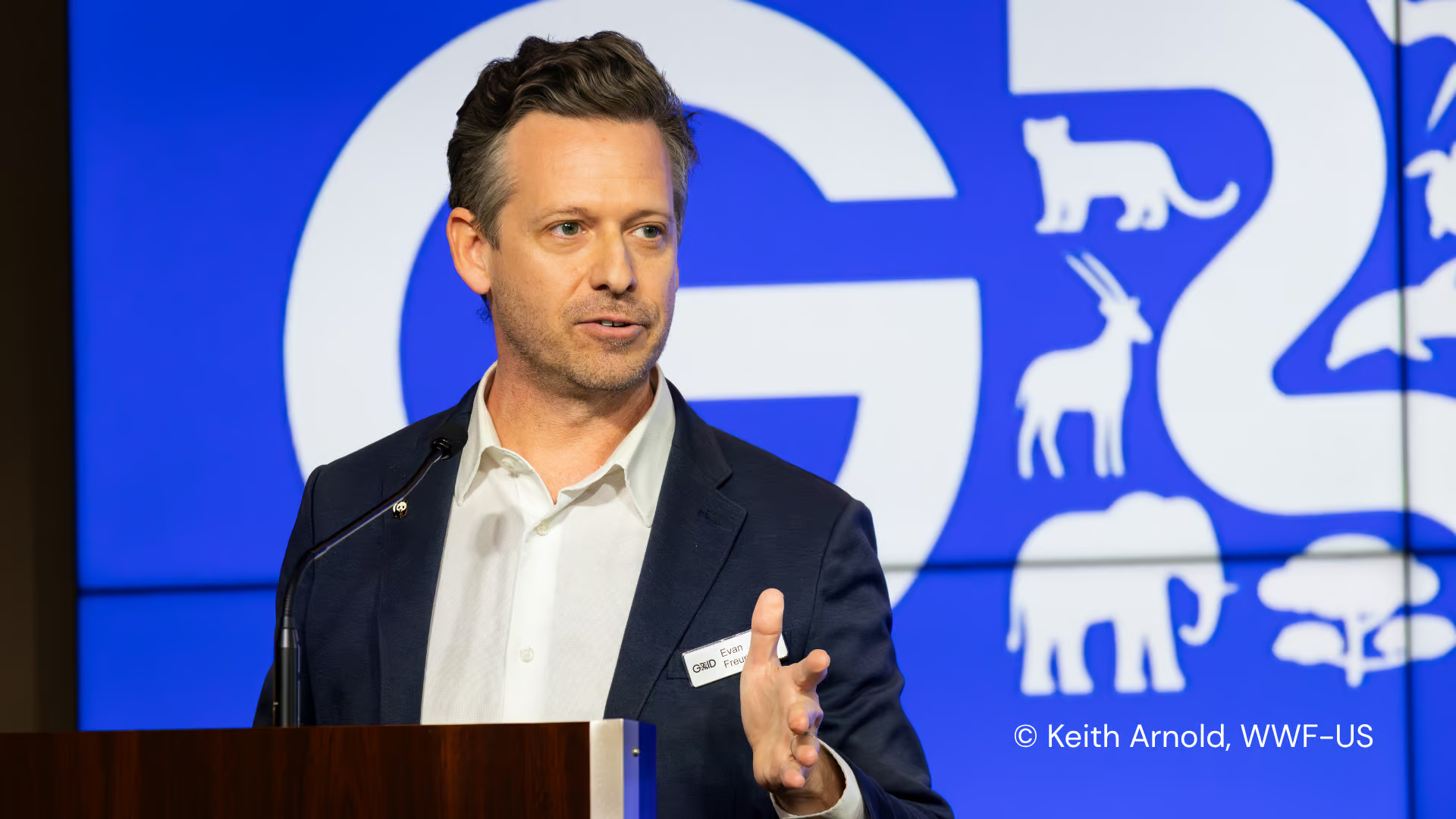
At WWF, Evan Freund manages programming around infrastructure design, finance, and development, including the five-year Greening Transportation Infrastructure Development (GRID) Integrated Program. Funded by the Global Environment Facility (GEF), GRID focuses on incorporating biodiversity and ecosystem-related considerations into transportation infrastructure planning.
In this interview Evan explains how nature-positive approaches can help tackle climate change and biodiversity challenges at the same time as investments increase to address the demand for additional transportation infrastructure.
Hi Evan! Thanks for sitting down with us for this conversation. Could you please introduce yourself and tell us about your role as the Senior Director, Sustainable Infrastructure, Forests at WWF?
I am a Senior Director for Sustainable Infrastructure within the WWF-US Forests Team. Broadly, my work – and that of our team – focuses on how major infrastructure decisions can better account for nature, biodiversity, climate resilience, and the needs of communities. More specifically, we aim to look beyond individual projects and instead influence the wider systems associated with infrastructure – public policy, spatial planning, finance and investment, engineering, science and research, and procurement.
You are managing the Greening Transportation Infrastructure Development (GRID) Integrated Program. Could you tell us more about the program?
GRID is a five-year, $27 million program funded by the Global Environment Facility (GEF) and implemented through a partnership between WWF, the Asian Development Bank (ADB), the United Nations Environment Programme (UNEP) and five participating countries: Malaysia, Nepal, the Philippines, Suriname, and Ukraine.
The central premise of GRID is that biodiversity and ecosystem-based considerations should be better integrated into the earliest stages of transportation infrastructure (roads, rails and ports) planning and development. At the country level, the program supports governments in strengthening institutions, policies, planning tools, and decision-making processes. At the global level, it is developing guidance, partnerships, technical resources, and communities of practice that can help move the wider transport sector toward more nature-positive approaches.
The broader ambition of GRID is to demonstrate practical models that can influence how transport infrastructure is planned and financed more widely. Innovative partnerships with a variety of public and private sector stakeholders in the transportation-infrastructure sector are therefore critical to the success of GRID.
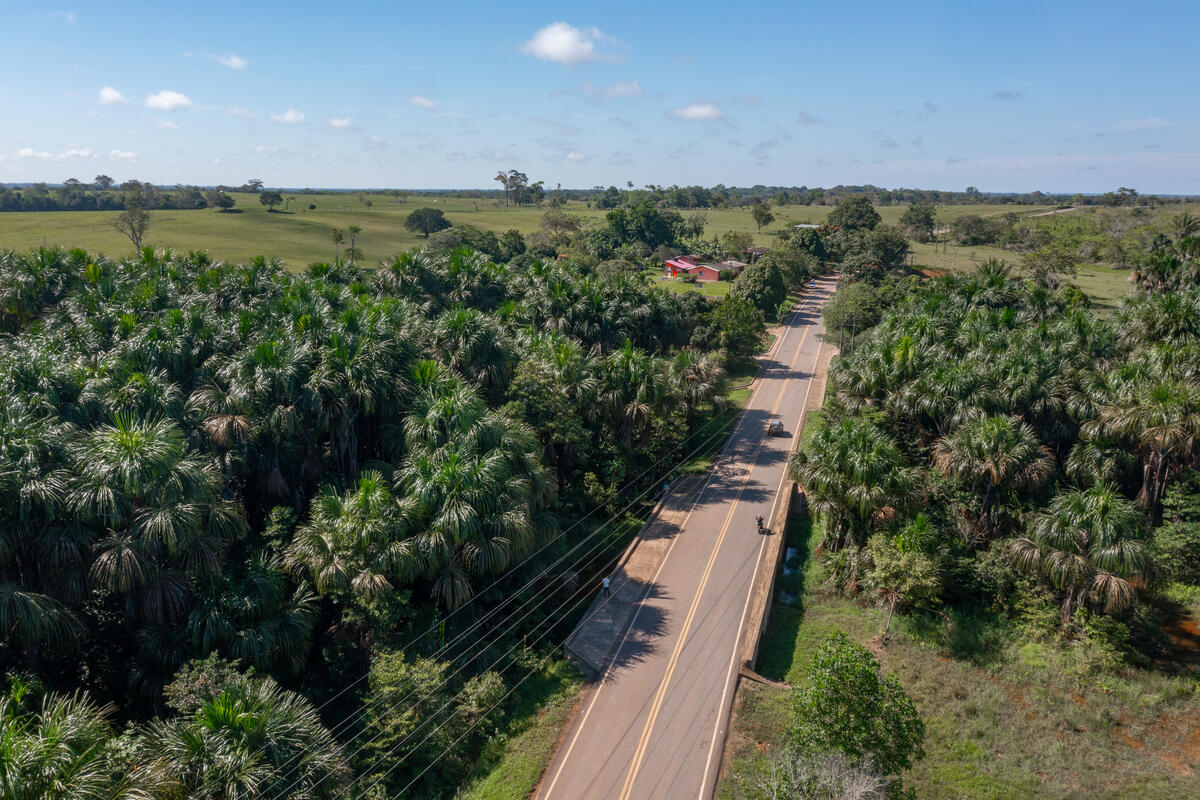
Colombia, WWF has worked with government and local partners to design guidelines for environmentally sustainable roads. The Green Road Infrastructure Guidelines are now mandatory and are being piloted in the rebuilding of this road in the Amazonian department of Guaviare. © WWF-US/Luis Bernardo Cano
You are working with 5 partner countries. Could you please tell us more about the motivation of these countries, why did they join the program?
The five countries are very different, but they face a common challenge: they all need infrastructure investment, while also managing significant biodiversity, climate, and development pressures.
For some, the motivation is closely related to rapid economic growth and expanding transport networks. They want to avoid locking in patterns of development that fragment ecosystems or create costly environmental and social impacts later. For others, the priority is strengthening both transportation and ecological connectivity, creating opportunities to simultaneously address economic and environmental considerations.
Ukraine presents a distinct but particularly important case. Reconstruction creates an enormous need for infrastructure investment, but also an opportunity to ensure that rebuilding is resilient, environmentally responsible, and aligned with long-term European and international standards. Suriname also presents a challenging planning paradigm. The project is focused on upcoming port development projects – driven in large part by expansive hydrocarbon production – which are positioned within Suriname’s ecologically significant coastal and marine ecosystems. The construction of ports, upgrading of connecting access roads, and increased shipping traffic can lead to environmental impacts on these ecosystems, including vital mangrove habitat.
What unites the countries is the recognition that transportation planning cannot be separated from land-use planning, biodiversity conservation, climate adaptation, and economic development. Each joined GRID because they see value in bringing those considerations together earlier and more systematically. One of GRID’s strengths is that it allows countries to pursue a shared objective through approaches tailored to their own needs.
Which countries or regions have demonstrated particularly promising approaches that others could learn from?
Colombia’s Green Road Infrastructure Guidelines (Lineamientos de Infraestructura Verde Vial) are a fantastic example of sustained and coordinated multistakeholder engagement resulting in comprehensive tools and corresponding policy associated with sustainable road development. The GRI are detailed planning and technical guidelines that integrate environmental, climate, social, economic, and engineering considerations throughout the lifecycle of road infrastructure projects. They are designed to prevent, mitigate, and correct possible indirect and direct negative environmental impacts of road construction and to support national and local development while maintaining surrounding ecosystems and communities. In 2024, the Government of Colombia signed a resolution making the GRI mandatory for all national roads across Colombia – a great demonstration of mainstreaming biodiversity into transportation planning and development.
The GRID program is also establishing a CoP on transport and biodiversity. What would you tell a decision-maker, a transport planner, an investor, why should they join this platform? Why should transport planners and policymakers care about biodiversity if their primary objective is improving mobility and economic development?
For decision-makers, the Community of Practice on Nature and Infrastructure (CoPNI) provides access to a growing body of knowledge, tools, case studies, and peer expertise that can support better-informed decisions and improve project outcomes. Often, critical information and lessons learned remain fragmented across institutions, sectors, and geographies. A fundamental ambition of CoPNI is to help reduce these information silos, and CoPNI enables members to learn from one another, avoid repeating costly mistakes, and identify solutions that can improve infrastructure performance while reducing environmental and social risks.
Ultimately, biodiversity should not be viewed as an obstacle to infrastructure development, but as a key determinant of long-term infrastructure performance and resilience. Projects that better account for nature are often more resilient to climate impacts, face fewer delays and conflicts, attract higher-quality investment, and deliver more sustainable economic outcomes.
There is only upside in joining CoPNI or participating in CoPNI-facilitated events! It exists to help infrastructure professionals realize these benefits by connecting them with the knowledge, partnerships, and practical solutions needed to deliver infrastructure that is both economically successful and nature positive.
More information about CoPNI is available at https://gridip.org/community.
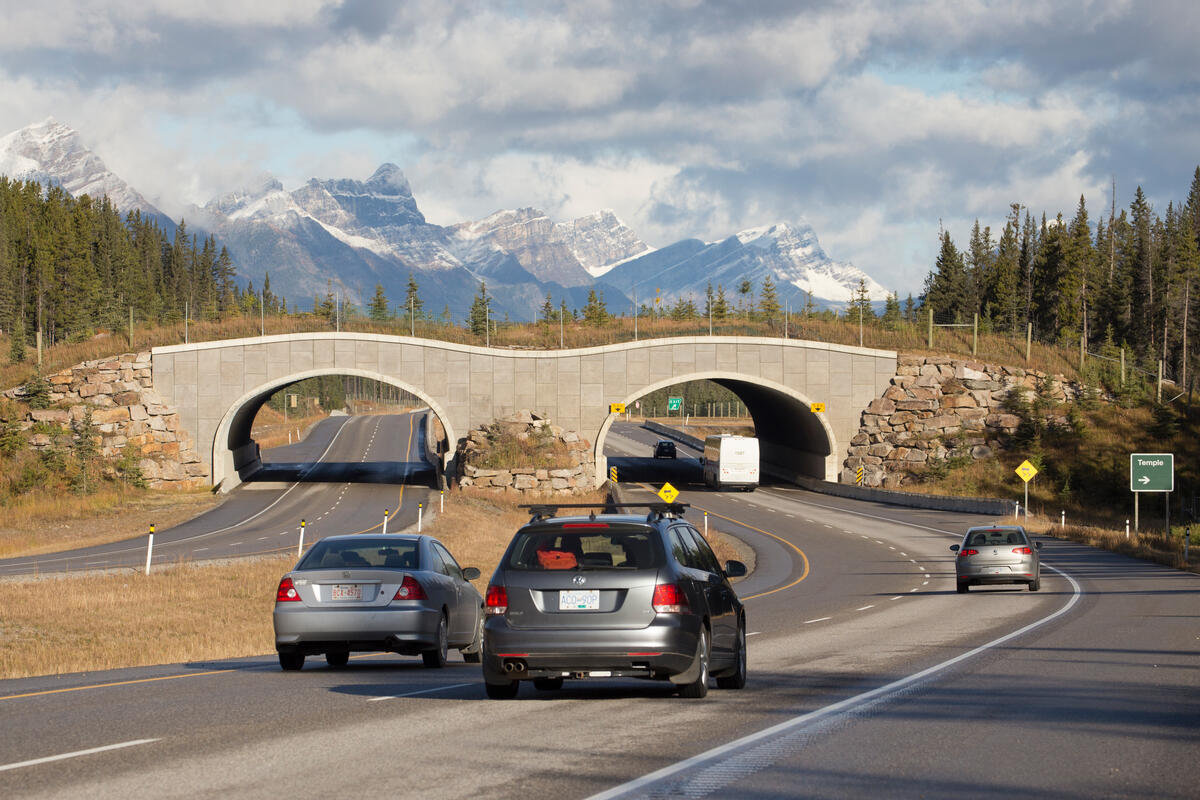
overpass across a busy highway provides a wildlife corridor in Banff National Park, Alberta, Canada. © naturepl.com / SCOTLAND: The Big Picture / WWF
Could you share one or two practical examples of nature-positive approaches to transportation infrastructure development? What are some practical measures that can make roads, railways, or other transport infrastructure more nature-positive?
Rather than sharing a particular example of a single project or approach, I’d highlight two resources that serve as helpful guidance for practitioners in this evolving space. The first “A Playbook for Nature Positive Infrastructure Development” is a collaborative effort between WWF and the International Federation of Consulting Engineers (FIDIC) which aims to demonstrate good practices and approaches in applying nature-positive principles to infrastructure development. The second, Towards “Nature Positive for the Ocean: Pathways for Port Sector Contributions” is a newly develop resource under GRID offers practical, science-based pathways to help port planners, developers, operators, and owners credibly contribute to global nature-positive goals: halting and reversing biodiversity loss by 2030 and achieving full recovery by 2050.
What are the primary challenges or roadblocks you observe today when trying to implement nature-positive transport infrastructure development approach?
There are quite a few challenges associated with implementing approaches to nature-positive transport infrastructure development. I’ve highlighted a few critical issues that GRID aims to address:
- Generally, one of the biggest challenges is timing. Nature-related considerations are often introduced too late in the development process. Environmental specialists may become involved only after the route, budget, financing structure, and political commitments have largely been determined. At that stage, the available options are much narrower.
- A second challenge is institutional fragmentation. Transport ministries, finance ministries, planning authorities, environmental agencies, development banks, and local governments often operate under different mandates, datasets, budgets, and timelines. Nature-positive outcomes require coordination across institutions that may not routinely work together.
- A third challenge is the way projects are appraised. Traditional cost-benefit analysis often captures construction costs, travel-time savings, and economic returns more easily than ecosystem services, cumulative impacts, induced development, or long-term biodiversity loss. If nature isn’t appropriately accounted for (as a benefit) in the project appraisal process, it is likely to remain invisible in the decision or simply treated as a costly externality.
- Procurement is another major gap. Biodiversity considerations may appear in policy documents but tend to be absent from technical specifications, tender criteria, contractor obligations, and performance indicators.
- There are also data and capacity constraints. Governments may lack sufficiently detailed biodiversity information, spatial-planning tools, ecological expertise, or the institutional capacity to evaluate alternatives.
- Finally – and similar to the above – there is a perception that biodiversity protection slows development or increases costs. Sometimes nature-positive measures do require additional up-front investment. But poor planning can also create much larger long-term costs through conflict, delays, flooding, landslides, litigation, ecosystem degradation, and infrastructure failure.
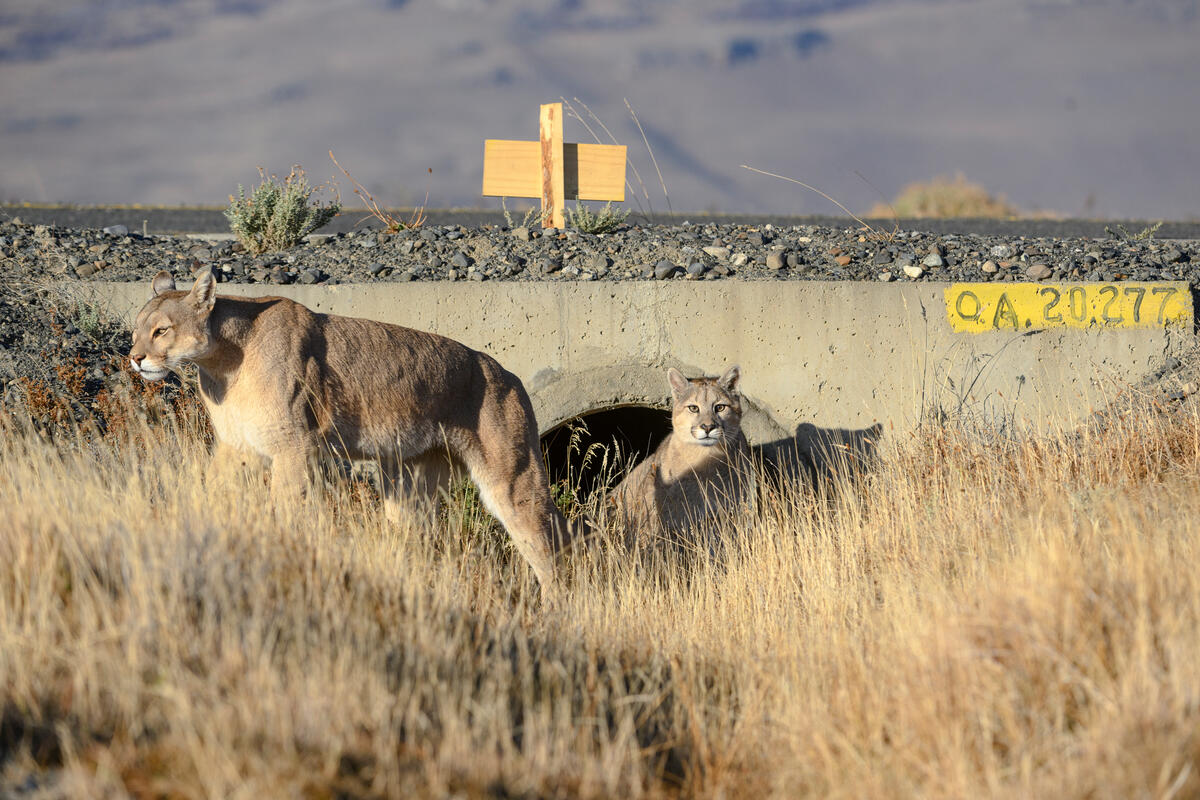
emerge from a culvert beneath a road in Torres del Paine National Park in Patagonia, Chile. © Nick Garbutt / naturepl.com / WWF
As WWF, you are also engaged under the UN Decade of Sustainable Transport and in frequent exchange with the transport community. What do you think, what should the transport sector aim for in the next decade? What would success look like for nature-positive transport infrastructure, and how will we know we’re on the right path?
The UN Decade on Sustainable Transport is such a timely and important effort to align and harmonize goals in this very dynamic sector. The next decade should be about broadening the definition of sustainable transport. The sector has made important progress on decarbonization, access, safety, inclusion, and urban mobility. These priorities remain essential. But a transport system cannot be considered fully sustainable if it reduces emissions while continuing to fragment ecosystems, accelerate deforestation, damage waterways, or undermine the natural systems on which economies and communities depend. Success would therefore mean that biodiversity is treated as a core planning and investment consideration rather than as a secondary environmental safeguard.
Ultimately, we will know we are on the right path when nature-positive transport is no longer seen as a specialized environmental agenda. It will simply be understood as good transport planning: economically sound, socially inclusive, climate-resilient, and compatible with the long-term health of the ecosystems on which development depends.
Thank you for taking the time to speak with us. We look forward to learning more about your work and nature-positive transport infrastructure at our upcoming TUMI Conference.